MACH | CNC HORIZONTAL BENDERS

POWER . PRECISION . VERSATILITY

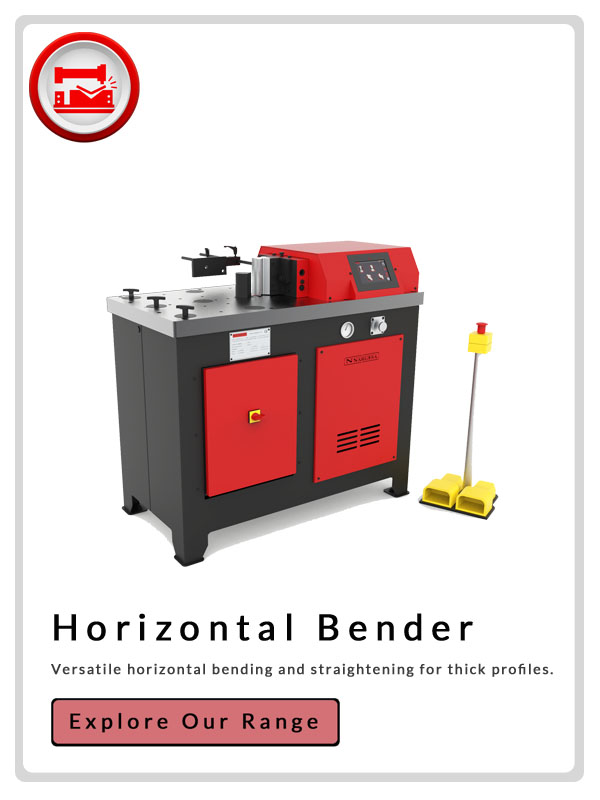
MACH CNC horizontal bending machines deliver powerful, accurate and repeatable forming of flat bar, steel plate and metal profiles. Combining high-force hydraulic technology, intelligent CNC control and versatile tooling, our horizontal bending presses are engineered for demanding fabrication, precision forming and efficient production across the UK & Ireland.

CNC Horizontal Bender Uk and Ireland

Capacities, available operations and control features depend on the selected machine and tooling configuration.

Technology & Features

ENGINEERED FOR PRECISION FORMING

Advanced horizontal bending technology. Built around hydraulic power, forming accuracy and production flexibility. Intelligent CNC controls, precision tooling and robust machine construction work together to deliver consistent results across a wide range of metal bending and straightening applications.
01

HYDRAULIC BENDING TECHNOLOGY

Powerful hydraulic cylinders deliver controlled horizontal forming force for bending thick plate, flat bar and solid metal sections. Rigid machine construction provides stability and supports consistent forming under demanding production conditions.

02

INTELLIGENT CNC CONTROL

Programmable CNC systems control ram positioning and bending sequences, allowing operators to store settings, repeat components and make controlled adjustments for material and tooling requirements.

03

PRECISION FORMING TOOLING

Interchangeable bending punches, dies and specialist tooling accommodate different material sections, bend geometries and forming applications. Correct tooling selection supports accurate bending and efficient production changeovers.

04

BENDING & STRAIGHTENING

Versatile horizontal press configurations support precision bending and, with suitable tooling, straightening of bars, welded components and selected structural sections. Controlled hydraulic force enables targeted forming and correction operations.

05

AUTOMATED POSITIONING

Optional CNC backgauges, programmable stops and material positioning systems simplify component alignment and improve repeatability across multiple bends and production batches.

06

MULTI-FUNCTION FORMING

From standard flat bar bending to specialist punching, shearing and profile forming, available accessories expand machine capability and provide flexible solutions for different workshop applications.

‎ ‎ ‎ ‎‎ ‎ ‎ MORE FORMING POWER. ‎ GREATER FLEXIBILITY. PRECISION IN EVERY BEND.

M MACH | Metalwork Machinery

HORIZONTAL BENDING QUESTIONS? WE’VE GOT ANSWERS

CNC HORIZONTALBENDERS FAQ & KNOWLEDGE CENTRE

Choosing the right CNC horizontal bending machine depends on your material thickness, forming force, component geometry, tooling requirements and production volume. MACH supplies, installs and supports hydraulic horizontal bending presses across the UK & Ireland, from versatile workshop machines to powerful CNC bending and straightening systems for demanding industrial applications.

A CNC horizontal bending machine is a hydraulic metal forming press that applies force horizontally to bend flat bar, plate, solid sections and selected metal profiles.

Unlike a conventional vertical press brake, horizontal bending machines use an accessible working table and interchangeable tooling to perform a variety of forming operations.

CNC control allows operators to program and repeat bending positions and sequences.

A hydraulic cylinder drives a movable ram or bending tool against the workpiece, which is supported by fixed dies or forming tools.

The controlled movement applies force to produce the required bend or shape.

The finished geometry depends on ram position, tooling design, material properties and machine settings.

A conventional CNC press brake is primarily designed to bend sheet metal and plate along
straight bend lines using an upper punch and lower die.

A horizontal bender uses a horizontal hydraulic ram and interchangeable tooling to form shorter, thicker or more specialised components.

Horizontal bending machines are particularly useful for flat bar bending, busbar forming, straightening and selected workshop operations.

Suitable horizontal bending machines can process mild steel, stainless steel, aluminium,
copper and other compatible metals.

The achievable bending capacity depends on material strength, section dimensions, tooling
and available hydraulic force.

Maximum bending thickness depends on the machine’s rated force, material width, grade,
tooling geometry and required bend.

For example, bending a narrow steel bar can require significantly less force than bending a wide plate of the same thickness.

The manufacturer’s capacity specifications should always be checked against the actual
component.

Yes. Hydraulic horizontal benders are widely used for forming flat bar, solid round bar, square bar and other selected metal sections.

Different profiles may require dedicated bending tooling to control the finished shape and
minimise unwanted deformation.

Yes. Suitable CNC horizontal bending machines can be configured for precision bending of copper and aluminium busbars.

Dedicated tooling and positioning systems can support accurate bend locations, repeatable angles and efficient production of electrical distribution components.

Yes. Suitable machines can perform straightening operations using specialised tooling and controlled hydraulic force.

Applications include straightening flat bars, shafts, welded assemblies and selected structural components.

The available straightening capacity depends on machine force, tooling arrangement and
material dimensions.

Some hydraulic horizontal bending presses can be equipped with optional punching, shearing and other processing attachments.

These functions depend on the machine’s design and available tooling.

For continuous high-volume punching or shearing, dedicated machinery may offer greater production efficiency.

CNC control provides programmable ram positioning, stored bending settings and repeatable operating sequences.

Depending on the machine, additional functions may include programmable backgauges, tooling libraries and bending corrections.

These features help reduce manual setup and improve consistency across repeated
components.

Tooling depends on the bending application and may include V -d ies, bending punches, forming pins, radius tools, straightening attachments and specialised profile dies.

Different material sizes, bend radii and component shapes may require dedicated tooling sets.

Yes. Suitable machines can produce multiple bends by repositioning the workpiece between forming operations.

Programmable bending sequences and optional CNC backgauges can improve consistency and simplify the production of components with several bend locations.

Accuracy depends on machine rigidity, ram positioning, tooling, material consistency and springback.

CNC control improves repeatability by maintaining programmed positions and allowing controlled adjustments.
Some advanced systems also offer automatic angle measurement and correction.

Start with the material type, maximum section dimensions, required bending force, bend
geometry and production volume.

Consider ram stroke, tooling height, available working area, CNC capabilities, backgauge requirements and optional forming attachments.

MACH can review your component drawings and production requirements to help select the appropriate machine capacity and tooling configuration.

Yes. MACH provides machinery installation, commissioning and operator training throughout the UK & Ireland.

Our team helps customers establish suitable machine setups, understand CNC operation and select appropriate bending tooling.

MACH provides technical support, servicing, maintenance assistance and spare parts support for the machinery we supply across the UK & Ireland.

Our focus is on maintaining machine reliability, reducing downtime and supporting long-t erm production performance.